How to Write Essay Fast: Ace Your Deadline
We’ve all been there: the deadline is looming, the cursor is blinking on a blank page, and panic starts to set in. But writing a good essay fast isn’t about magic; it’s about method. The secret is to swap that feeling of dread for a structured, timed workflow that prioritizes progress over perfection. Think of it as a strategic sprint, not a chaotic scramble.
Your 3-Hour Essay Writing Game Plan
Believe it or not, you can get from a blank document to a finished essay in just three hours. The trick is to be disciplined and have a clear plan of attack. Instead of letting anxiety take over, you’re going to channel that energy into a focused, step-by-step process. This isn’t about skipping important work; it’s about working smarter by focusing on what moves the needle.
This process breaks down into four critical stages, taking you from initial research all the way to the final polish.
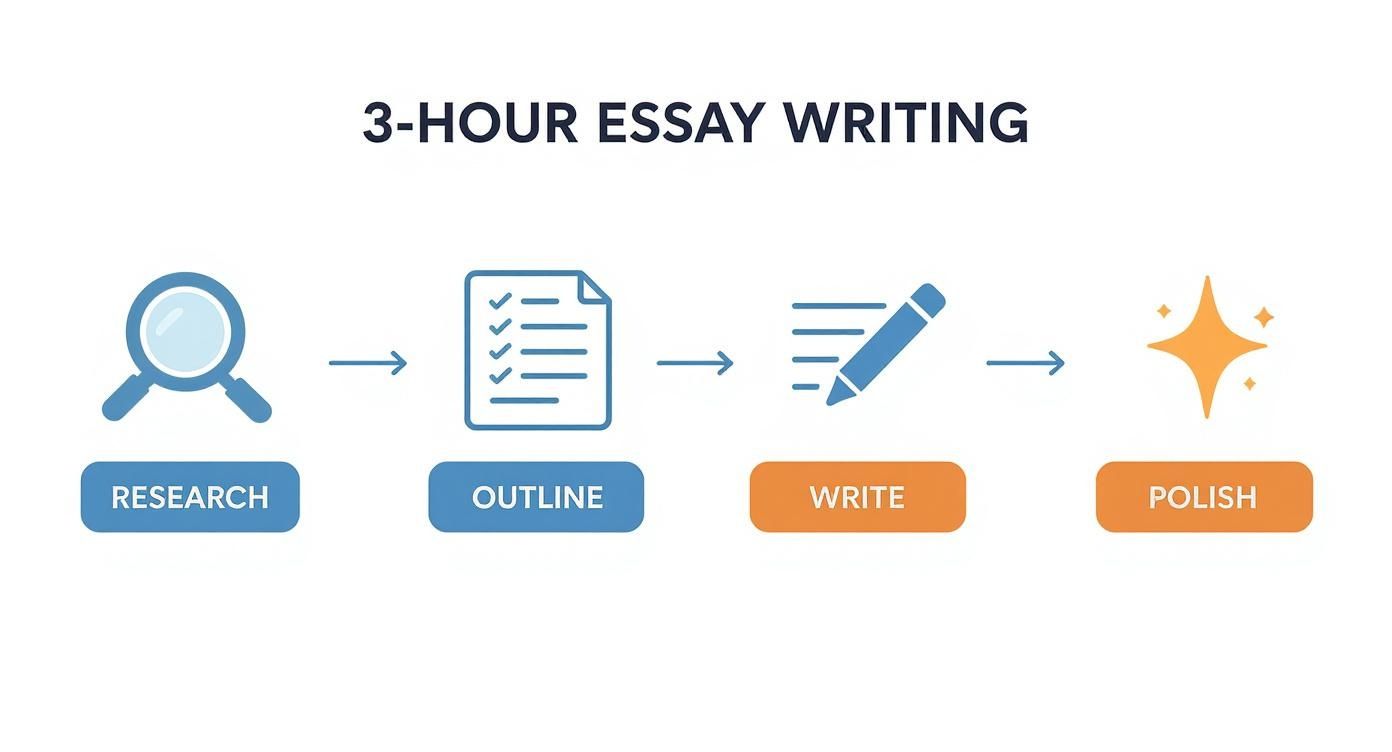
As you can see, the bulk of your time will be spent actually writing, but the prep and revision stages are just as crucial for a quality result.
The Time Allocation Strategy
When you’re racing the clock, time becomes your most precious asset. You have to ditch the multitasking and resist the urge to fall down a research rabbit hole. The entire goal here is to build and maintain forward momentum.
So, how do you actually divide your time? I’ve found that a specific, non-negotiable schedule is the best way to stay on track. This table breaks down exactly how to spend your 180 minutes.
The 3-Hour Essay Writing Timeline
A strategic breakdown of how to allocate your time for maximum speed and efficiency when writing an essay under pressure.
| Stage | Time Allocation | Key Objective |
|---|---|---|
| Rapid Research & Pre-Writing | 45 Minutes | Decode the prompt, find 3-5 core sources, and brainstorm your main arguments. |
| Bulletproof Outlining | 30 Minutes | Build the essay’s skeleton with a clear thesis, topic sentences, and evidence points. |
| Speed Drafting | 75 Minutes | Get words on the page. Follow your outline and turn off your internal editor. Just write. |
| Strategic Polishing | 30 Minutes | Focus on high-impact edits: check for clarity, fix glaring errors, and proofread. |
Sticking to a timeline like this does more than just manage your time—it gives you a clear, actionable path forward that can quiet the anxiety of a fast-approaching deadline.
Each stage logically builds on the one before it, making the whole process feel much more manageable. You’re not just writing; you’re building a well-reasoned essay, piece by piece, in the most efficient way possible.
Mastering the First 45 Minutes: Rapid Research and Pre-Writing
The first 45 minutes of your three-hour window are, without a doubt, the most critical. Think of this not as a chore, but as a strategic mission. If you nail this part, the rest of the essay practically writes itself. You’ll be connecting the dots instead of staring at a blank page, wondering where to even begin.
First things first: you have to break down your essay prompt. I mean really dissect it. Don’t just glance at it. Pull out the keywords and, more importantly, the command words—verbs like “analyze,” “compare,” or “evaluate.” These tell you exactly what you need to do. Ignoring them is the fastest way to write a beautiful essay that completely misses the point.
Your prompt isn’t a suggestion. It’s the rulebook for the game you’re about to play. To win, especially on a tight deadline, you have to know every single rule.
The Surgical Research Strike
Once you have the prompt memorized, your research becomes a targeted strike, not a sprawling expedition. You are not trying to become the world’s foremost expert on the topic in the next 20 minutes. Your only goal is to find 3-5 solid, credible sources that give you the ammunition you need.
Here’s how to find what you need, fast:
- Become a Search Ninja: Use quotation marks for exact phrases (like
"social contract theory" Hobbes) and the minus sign to cut out the noise (e.g.,impressionist art -Monet). This simple trick makes Google your best friend. - Read the Bookends First: When you find a promising academic paper, don’t dive into the whole thing. Read the abstract and the conclusion first. They give you the entire argument in a nutshell, letting you decide in under a minute if it’s worth your time.
- Follow the Breadcrumbs: Found one killer source? Great. Now scan its bibliography or footnotes. This is a goldmine for finding other high-quality materials that the experts themselves are citing.
This focused approach is everything. The time it takes to write an essay can vary dramatically; a beginner might struggle for four hours on a 1000-word piece, while a seasoned writer could knock it out in less than one. A huge part of that difference is getting bogged down by trying to research and write at the same time, a habit that can slow your writing speed to a crawl—as low as 5 words per minute. By keeping these tasks separate, you maintain your momentum. You can see a detailed analysis of what influences writing speed to learn more.
Get Your Ideas on the Page—Fast
With a handful of good sources, it’s time to let the ideas fly. Don’t censor yourself here. Just get it all out. Set a timer for 10 minutes and pick whatever method feels most natural.
- Mind Mapping: A personal favorite. Put your main topic in the center and just branch out with ideas, evidence, and potential counterpoints. It’s fantastic for seeing how everything connects visually.
- Freewriting: Open a blank document and just type. Don’t stop, don’t edit, don’t judge. The goal is pure idea generation, a brain dump to get the raw material out in the open.
- The Bullet List: The simplest method of all. Just create a running list of every single point or argument you can think of. You can worry about organizing it later.
After these 45 minutes, you should have a firm grasp of the prompt, a small stack of relevant sources, and a messy but promising list of arguments. This isn’t just prep work. It’s the launchpad that will propel you through the drafting phase with speed and confidence.
Building a Bulletproof Outline in 30 Minutes
If your initial research is the launchpad, a solid outline is the guidance system. This isn’t just a simple list of topics; think of it as the architectural blueprint for your entire essay. When you have a great plan in place, drafting stops feeling like a creative struggle and becomes more like connecting the dots.
The best part? You can knock out this entire framework in just 30 minutes.
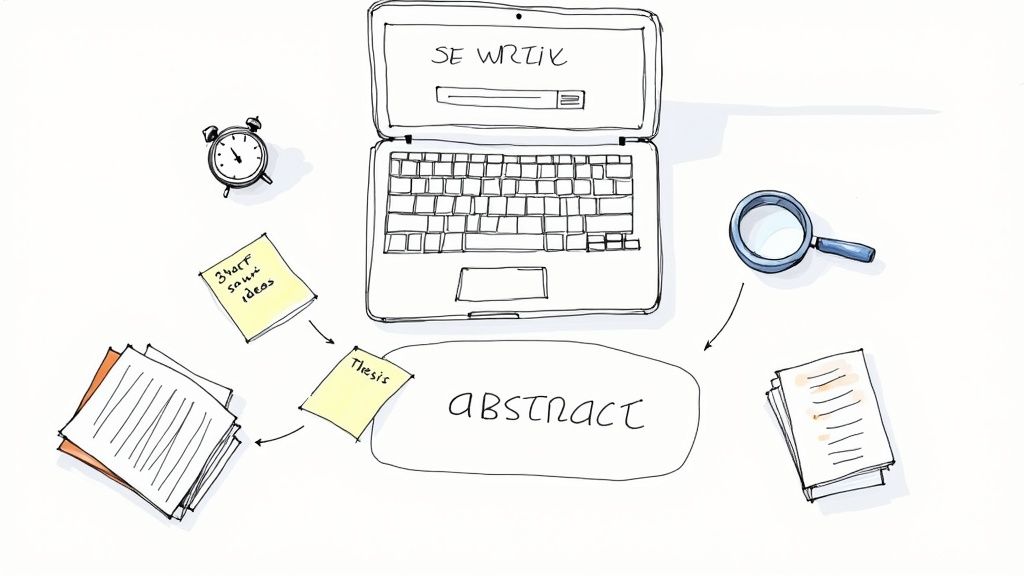
The real secret to writing an essay fast is knowing exactly what you’re going to say before you even start worrying about full sentences. This is why a detailed outline is non-negotiable. It gives your paper structure, makes sure your argument flows logically, and—most importantly—stops you from wandering off on time-wasting tangents. You wouldn’t build a house without a blueprint, right? Don’t even think about writing an essay without an outline.
Nail Your Thesis Statement
Your thesis is, without a doubt, the single most important sentence in your entire essay. It’s the North Star guiding every single word you write. A powerful thesis isn’t just a statement of fact; it’s a debatable claim that you’ll spend the rest of your essay proving.
Dedicate the first 5-10 minutes of your outlining time to getting this one sentence perfect. It needs to be sharp, specific, and a direct answer to the essay prompt. If you’re having trouble pinning down your main point, don’t be afraid to use a quality thesis statement generator to help crystallize your ideas into a focused argument.
A vague thesis leads to a wandering essay. A sharp, debatable thesis forces you to build a focused, persuasive argument from the very first paragraph.
Map Your Topic Sentences
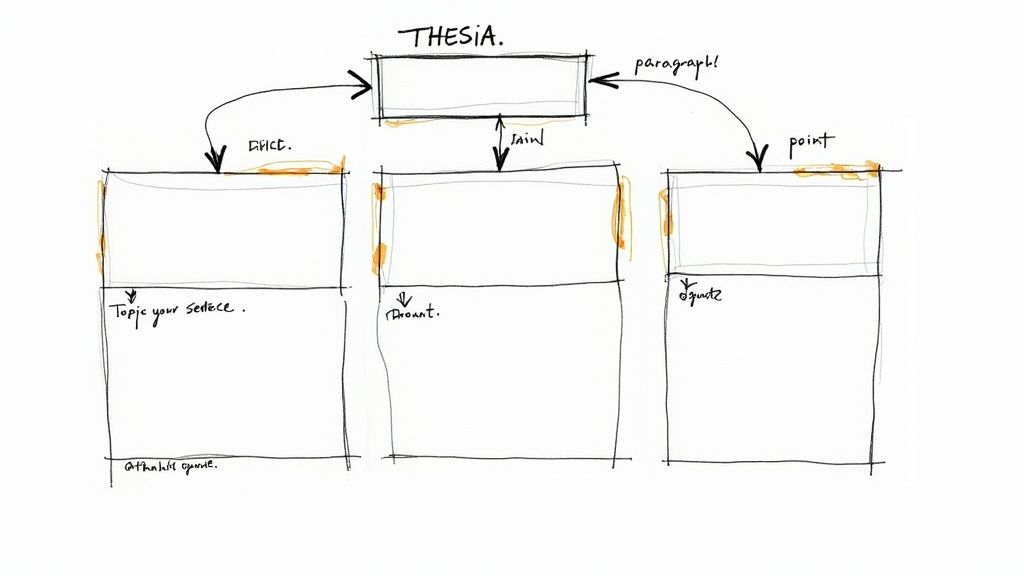
Once your thesis is locked in, spend the next 15 minutes mapping out the body paragraphs. For each paragraph, your goal is to write a single topic sentence that functions as a mini-thesis. Every one of these sentences must directly support your main argument.
Think of your essay like a court case. Your thesis is the final verdict you want the jury—your reader—to reach. Your topic sentences are the key arguments your lawyers will present to get them there.
- Paragraph 1: Lead with your strongest argument. This topic sentence should introduce the most compelling piece of evidence that backs up your thesis.
- Paragraph 2: Build on that first point. This sentence can bring in a related idea or a different angle that reinforces your overall claim.
- Paragraph 3: Consider addressing a potential counter-argument or introducing a nuance. This demonstrates critical thinking and ultimately makes your position even stronger.
Plug In Your Evidence
In the final 5-10 minutes, it’s time to slot your research directly into this new framework. Go back to your notes. Under each topic sentence, add a few bullet points with the specific quotes, statistics, or facts you gathered earlier. This step is a game-changer because it ensures every piece of evidence has a clear and defined purpose.
This methodical approach has been proven to speed up the writing process significantly. Taking the time to craft a solid outline before you start drafting can slash your total writing time by up to 30% simply by organizing your thoughts ahead of time. Suddenly, writing the essay feels less intimidating and more like you’re just telling a story to a friend—with a clear beginning, middle, and end that you’ve already mapped out.
The 75-Minute Rapid Draft
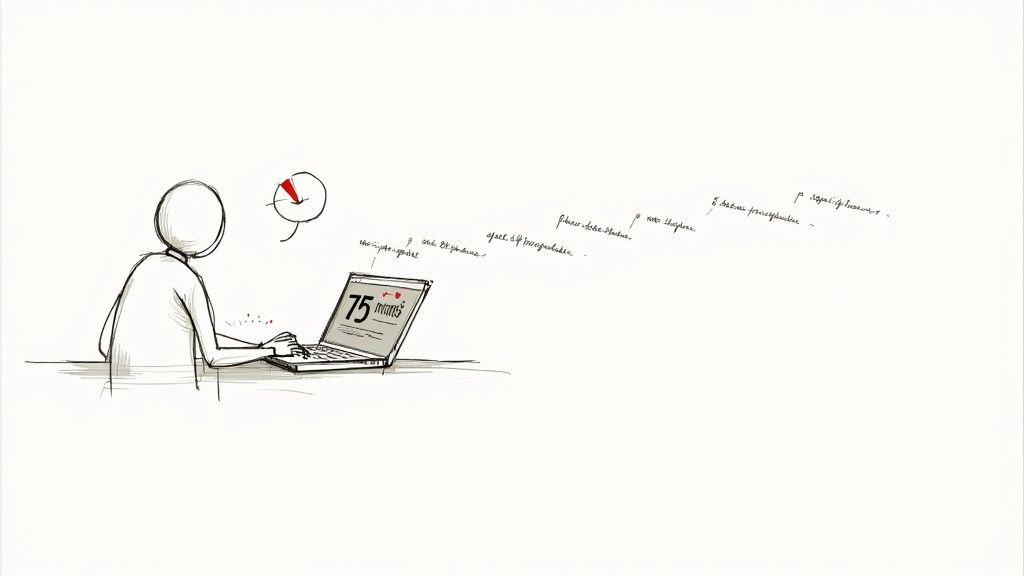
Alright, this is where all that prep work really starts to shine. You’ve got 75 minutes on the clock for a focused sprint. The mission? Get every idea from your outline onto the page.
There’s one golden rule here: shut down your inner critic. Just write.
Don’t worry about finding the perfect word or crafting a flawless sentence. This is all about momentum. Think of it as a “brain dump”—the goal is to get the core of your argument down, not to create a masterpiece. We’ll polish it later.
Hit the Body Paragraphs First
I know it sounds backward, but trust me on this: skip the introduction for now. Trying to write the intro first is a classic time-wasting trap. How can you introduce an essay you haven’t even written yet? You’ll just spin your wheels trying to come up with a brilliant opening.
Instead, dive right into your body paragraphs. Pick the point from your outline that feels the easiest or most exciting. Getting a quick win builds confidence and gets you into a rhythm. Your only task is to flesh out the topic sentences you already wrote.
Use Placeholders to Keep Your Momentum
One of the biggest speed bumps when writing fast is stopping to look something up. Every time you halt to find a specific date, format a citation, or search for a better word, you kill your flow and break your concentration.
The solution is simple: use placeholders.
- Missing info? Can’t remember a statistic? Just type
[find stat on X]or[confirm treaty year]and keep moving. - Citations needed? Don’t get lost in formatting rules. Just drop in
(Author, page #)and handle the details later. - Awkward sentence? If a phrase feels clunky, just highlight it or add a note like
[REPHRASE]and come back to it during the editing phase.
This isn’t just about being lazy; it’s about managing your cognitive load. By pushing small decisions to the side, you free up all your brainpower for the main event: getting your thoughts down.
The real bottleneck in fast writing isn’t how fast you can type—it’s how fast you can think. Placeholders let your fingers keep up with your brain without the constant interruptions of self-editing.
Write the Conclusion and Intro at the End
Once the body of your essay is drafted, you’ll have a crystal-clear picture of what your argument actually is. Now, writing the conclusion is a breeze. Spend about 10-15 minutes pulling your main points together and restating your thesis in a fresh way.
Last but not least, loop back to the introduction. Now that you know exactly where your essay went, you can craft a powerful, focused intro that perfectly sets the stage for the reader. This reverse-order strategy is the secret to a coherent and tightly-argued paper. If you’re stuck on a hook, there are plenty of free writing tools that can help spark an idea.
Strategic Polishing and Proofreading
You’ve got a complete draft, and now you’re on the final 30-minute sprint to the finish line. This isn’t the time for a deep, soul-searching rewrite. Think of this as a targeted strike—a quick, strategic polish focused on making the biggest impact in the shortest time.
Your mission is to transform that collection of raw ideas into a coherent, persuasive, and clean essay. The secret is to work in focused passes, tackling one type of issue at a time. It’s a far more efficient way to edit than trying to fix grammar, structure, and flow all at once.
First Pass: The Big Picture Check
Spend your first 10 minutes looking at the essay from a 30,000-foot view. Forget about commas and spelling for now. We’re checking the architectural integrity of your argument.
Run through this mental checklist:
- Does the essay actually answer the prompt? (It’s a surprisingly common mistake!)
- Is your thesis statement crystal clear in the introduction?
- Does each body paragraph’s topic sentence directly support that main thesis?
- Do the paragraphs flow logically, or does it feel like a random collection of points?
This high-level review is non-negotiable. When you’re writing fast, it’s easy to drift off-topic. This step pulls you back on track, ensuring your essay is structurally sound before you waste time polishing sentences that might not even belong.
Second Pass: Smoothing Out the Sentences
Alright, now zoom in. Dedicate the next 10 minutes to sentence-level refinements. This is where you hunt down and fix awkward phrasing, clumsy repetition, and any spots where your meaning is muddy. Your rapid draft was about getting thoughts on the page; this pass is about making them sing.
Pro Tip: Read your essay out loud. Seriously. Your ears are incredible at catching clunky phrasing and unnatural rhythms that your eyes just skim over.
Look for places to combine short, choppy sentences into a more sophisticated thought. Conversely, find those long, winding sentences and break them up for clarity. Swap out repeated words with synonyms to keep your writing fresh and engaging.
Final Pass: The Meticulous Proofread
Your last 10 minutes are for the final sweep. This is your meticulous hunt for all the small-but-costly errors that can drag down your grade—grammar goofs, spelling mistakes, and punctuation problems.
Here’s a great trick: temporarily change the font or text size of your document. It tricks your brain into seeing the text fresh, making it way easier to spot typos you’ve gone blind to.
And don’t forget your citations. If you dropped in placeholders, now’s the time to make them perfect. Using an online citation generator tool can be a lifesaver here, ensuring accuracy and consistency without eating up your final precious minutes.
Got Questions About Writing Essays Fast?
Even with a solid plan, a few nagging questions can pop up when you’re trying to write a great essay under pressure. Let’s clear the air and tackle some of the most common hurdles I see students face.
Should I Write the Introduction or Conclusion First?
This is a classic debate, but when speed is the name of the game, the answer is surprisingly simple: write both of them last. It feels a little backward, but trust me, it’s a game-changer.
Think about it. How can you properly introduce an argument you haven’t even written yet? Trying to nail the perfect opening hook before the body of your essay exists is a fast track to writer’s block.
Instead, jump straight into your body paragraphs. Your outline is your roadmap, so just start building your case point by point. Once all your evidence and analysis are on the page, the conclusion practically writes itself—you’re just summarizing what you’ve already proven. From there, you can loop back and craft a killer introduction that perfectly tees up the brilliant essay that follows.
My Go-To Strategy: I always write the body paragraphs first, knock out the conclusion, and then circle back to write the introduction. It guarantees your intro is a perfect match for your final argument and saves a ton of time on rewrites.
What Are the Biggest Time-Wasting Mistakes?
When you’re on the clock, every second counts. It’s usually not slow typing that derails students; it’s the hidden time sinks that kill momentum and add unnecessary stress.
Here are the top culprits I see all the time:
- Editing while you draft. This is the number one momentum killer. Constantly stopping to fix a typo or tweak a sentence is like hitting the brakes every ten seconds on the highway. Your only goal for the first draft is to get it done. Get the ideas down, and worry about making them pretty later.
- Going down a research rabbit hole. We’ve all been there. You start looking for one specific stat and an hour later you’re an expert on something completely irrelevant. Stick to your outline and only look for the specific evidence you need to support your points.
- Misreading the prompt. Writing a fantastic essay that doesn’t answer the question is a heartbreaking way to fail. Before you write a single word, spend five solid minutes breaking down the prompt. Identify the keywords and understand exactly what it’s asking you to do.
Steering clear of these traps can easily save you an hour or more of pure frustration. The trick is to keep your writing stages separate: research, outline, draft, and edit. Give each stage your undivided attention.
How Can I Use AI for Brainstorming Without Plagiarizing?
AI writing tools are everywhere now, and students are definitely taking notice. A recent report found that by early 2025, around 31% of internet users globally are using AI assistants for writing tasks. The key is to use them ethically—as a smart assistant, not a ghostwriter.
You can see the data on these global AI trends yourself to understand how technology is becoming a part of the academic process.
Here’s how to use AI the right way:
- Generate ideas, not finished text. Give the AI your essay prompt and ask it for potential arguments, counterpoints, or different angles to consider. Use its output as a springboard to build your own original outline.
- Summarize and synthesize sources. If you’re staring at a dense, 30-page academic journal article, ask an AI tool to pull out the main points for you. This can slash your research time, but the final analysis and how you weave it into your essay must be 100% yours.
- Never, ever copy and paste. This is the golden rule. Don’t take sentences or entire paragraphs from an AI and drop them into your paper. Use the ideas to fuel your own critical thinking and writing.
Treated as a brainstorming partner, AI can help you get past that initial blank-page paralysis and speed up your research, all while the final essay remains your authentic work.
When the deadline is looming and you need more than just a few tips, sometimes a little professional backup is in order. The team at Best Essay USA is made up of vetted academic experts who can provide the writing support you need to handle any challenge. Get the expert help you need to succeed.