How to Write a Good Hook and Grab Readers Fast
To write a good hook, you need to grab your reader’s attention right out of the gate, often in the very first sentence. This isn’t about just starting your essay; it’s about creating immediate curiosity with a startling fact, a thought-provoking question, or a relatable anecdote that gives them a real reason to keep reading.
Why Your Opening Sentence Is a Dealbreaker
Think of your first sentence as an audition. In a world overflowing with content, readers make split-second decisions about what’s worth their time. That opening line is your one chance to convince them to stick around and hear what you have to say.
Facing a tight deadline and a blinking cursor? The expert writers at Best Essay USA are on standby 24/7 to help you nail everything from the perfect hook to a powerful conclusion. You can get the support you need at bestessayusaA powerful hook does a lot more than just keep someone from clicking away. It’s a strategic tool that accomplishes several things at once:
- Establishes Credibility: A sharp, interesting opening tells the reader you’re a confident writer with something valuable to say.
- Sets the Tone: Is your piece serious and academic? Persuasive? Humorous? The hook immediately establishes the voice and mood.
- Creates a Promise: A great hook makes a silent promise that the rest of the piece will be just as insightful and engaging.
The Psychology of First Impressions
We all know attention spans are short, but the reality is staggering. Research shows that roughly 80% of readers decide whether to continue reading within the first 15 seconds. That’s an incredibly small window to make an impact.
This statistic puts immense pressure on your opening words. You aren’t just introducing a topic; you’re fighting for a sliver of your audience’s focus. A weak start like, “In this essay, I will discuss…” is a missed opportunity because it delays the payoff. A strong hook delivers value instantly, making the reader feel they’ve already learned something important.
Your hook is the gateway to your argument. If the gate is locked with a boring or generic statement, even the most brilliant ideas inside will remain undiscovered.
Ultimately, your hook is the foundation of any successful piece of writing. It’s the first—and most critical—step in building a connection with your reader. Mastering this skill isn’t just about writing better introductions; it’s about making your entire message more powerful. To see how this fits into the broader structure, check out our guide on how to write an introduction paragraph.
The 6 Most Powerful Types of Hooks to Master
If you want to write a good hook, you need more than one tool in your toolkit. Using the same type of opening for every single assignment—whether it’s a dense research paper or a personal blog post—is like trying to build a house with only a hammer. Different writing situations call for different tools, and understanding your options will instantly elevate your work.
Think of these hooks as different keys, each designed to unlock a reader’s curiosity. Some surprise them with cold, hard data, while others build an immediate personal connection through a shared story. The real skill is knowing which key to use for which lock.
Your first sentence is a critical decision point for every reader. They either stay, or they leave.
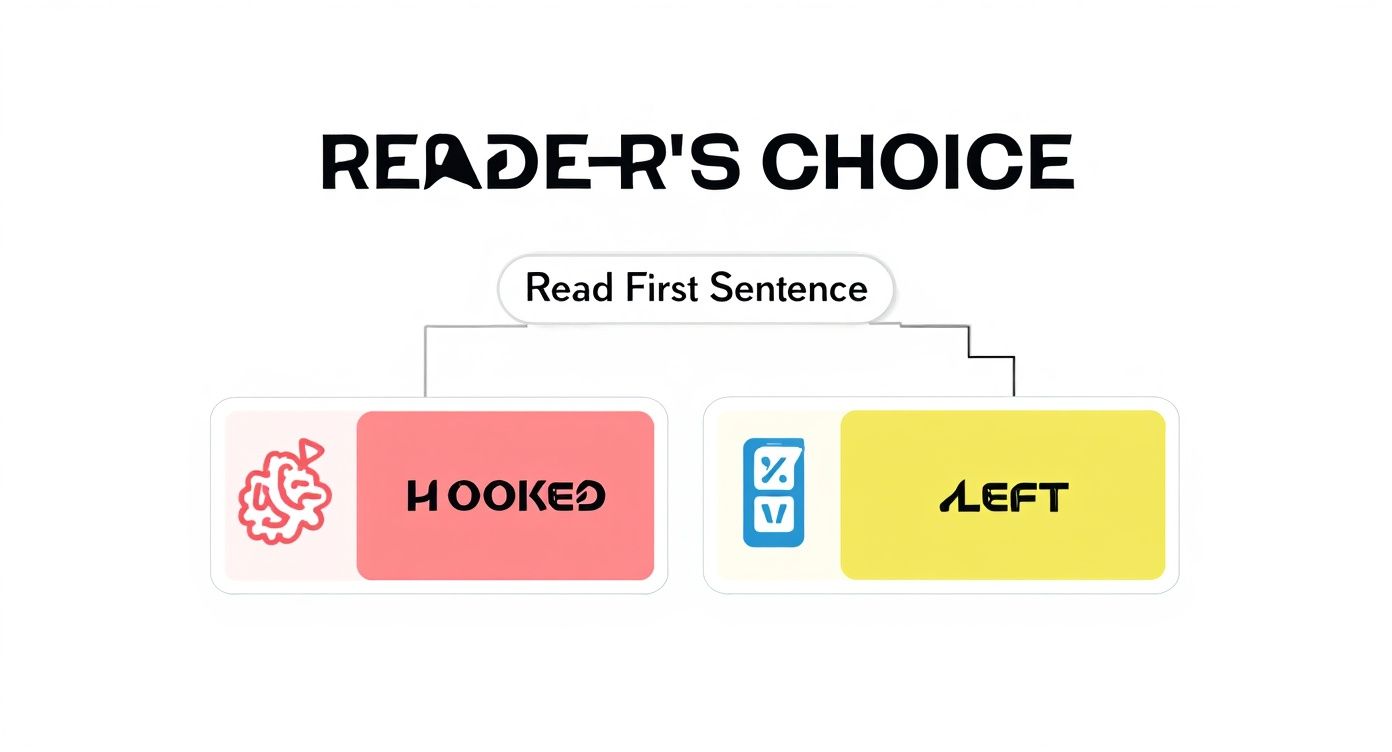
As you can see, that journey either continues because your hook landed, or it ends right there. Let’s walk through the six most reliable hook types to make sure your readers always choose to stick around.
1. The Anecdotal Hook
An anecdote is just a short, personal story that plugs your reader directly into the topic on an emotional level. This hook is incredibly effective because we’re all wired for stories. It immediately says, “I get this on a human level,” which builds instant trust.
This approach is perfect for personal essays, persuasive arguments, or any kind of creative piece. For example, starting an essay on overcoming failure with, “The first time I saw the rejection letter, I didn’t feel disappointment; I felt nothing at all,” hits much harder than, “Overcoming adversity is difficult.” The story creates a scene and invites empathy. If you’re trying to build a compelling personal story, our guide on how to write a narrative essay offers a more detailed roadmap.
2. The Startling Fact or Statistic Hook
Nothing grabs attention and establishes authority faster than a jaw-dropping piece of data. This hook works by shattering a reader’s assumptions or revealing the massive scale of an issue. The trick is to find a statistic that’s both genuinely surprising and directly relevant to your main point.
For instance, a paper on digital privacy could open with: “Every 60 seconds, over 5.9 million Google searches are performed—each one a permanent digital footprint.” That number is specific, huge, and immediately frames the topic as urgent.
3. The Question Hook
A good question hook pulls the reader directly into a conversation. You’re inviting them to think alongside you from the very first line. The key, however, is to avoid lazy “yes” or “no” questions. The goal is to pose a question that sparks real curiosity and can’t be answered in a single word.
Look at the difference:
- Weak: “Is social media bad for teenagers?”
- Strong: “What happens to a developing mind that replaces face-to-face interaction with a curated feed of digital perfection?”
The second one is far more compelling. It forces deeper reflection and perfectly sets the stage for a nuanced discussion.
4. The Quotation Hook
Using a quote from a well-known figure or an expert in the field lets you borrow a bit of their credibility. This type of hook can add a touch of sophistication to your introduction, positioning your argument within a larger, important conversation.
Just make sure the quote is impactful and clearly connected to your thesis. For an essay on innovation, you could lead with: “As Steve Jobs once said, ‘The people who are crazy enough to think they can change the world are the ones who do.'” This not only captures your theme but also leverages a widely respected voice to give your point more weight.
My Advice: Don’t just drop a quote and walk away. Always follow it up with your own sentence explaining why it matters and how it connects to the specific topic of your paper.
5. The Scenario Hook
This hook works by painting a vivid picture in the reader’s imagination. You create a hypothetical or real-world scene that fully immerses them in your topic. By using sharp, descriptive language, you can make an abstract concept feel tangible and immediate.
For a piece on urban planning, you might start with: “Imagine a city where your daily commute is a five-minute walk through a park, not a 45-minute crawl in traffic.” This “what if” scenario creates an appealing vision that makes the reader want to know how it could become a reality.
6. The Definition Hook
Okay, let’s be clear: starting with “Webster’s dictionary defines…” is a tired cliché you should absolutely avoid. But you can reinvent this hook. Instead of a bland, standard definition, offer a surprising or personal re-definition of a common term.
For example, an essay on resilience could begin with: “Most people think resilience is the ability to bounce back. But true resilience isn’t about returning to who you were; it’s about using the damage to forge something stronger.” This immediately challenges a common assumption and signals to the reader that you have a fresh perspective to share.
Choosing the Right Hook for Your Writing
Not sure which hook to use? This table breaks down where each type shines and the effect it has on your reader. Think of it as a quick-reference guide for your next assignment.
| Hook Type | Best For | Effect on Reader |
|---|---|---|
| Anecdote | Personal essays, narrative writing, persuasive speeches. | Creates an immediate emotional connection and builds rapport. |
| Startling Fact | Research papers, argumentative essays, informative articles. | Establishes authority and creates a sense of urgency or surprise. |
| Question | Persuasive writing, blog posts, opinion pieces. | Engages the reader’s mind and encourages them to think critically. |
| Quotation | Academic essays, historical analysis, literary critiques. | Adds credibility and frames the topic within a broader context. |
| Scenario | Creative writing, problem-solution essays, futuristic topics. | Immerses the reader in a vivid mental image, making concepts tangible. |
| Definition | Philosophical essays, concept analyses, papers with a unique thesis. | Challenges a common assumption and signals an original perspective. |
Ultimately, the best hook depends entirely on your topic, your audience, and the tone you want to set. Mixing and matching these based on the specific assignment will make your introductions far more dynamic and effective.
Using a Startling Statistic to Hook Your Reader
Sometimes, the best way to command attention is with a cold, hard fact. A shocking statistic cuts through the noise and immediately shows your reader that you’ve done your homework. It’s a powerful way to signal that your writing is grounded in reality, not just opinion.
Of course, not just any number will do. Tossing a random percentage into your opening sentence rarely works. The secret is finding a statistic that challenges a common assumption or reveals the true, often staggering, scale of a problem.
You’re looking for that “Wow, I had no idea” moment. That’s the spark that turns a casual skimmer into an engaged reader, eager to see what you have to say next.
Where to Find Your Data (And How to Frame It)
First things first: you need credible data. Pulling numbers from a random blog or an unverified social media post is a surefire way to lose credibility before you even start. You have to build your hook on a rock-solid foundation.
I always recommend sticking to trusted sources:
- Government Databases: Places like the Bureau of Labor Statistics or the Census Bureau are goldmines of unbiased data.
- Academic Journals: Search on Google Scholar or JSTOR for peer-reviewed studies with specific, verifiable findings.
- Reputable Research Organizations: Institutions like the Pew Research Center publish fantastic, in-depth reports on everything from technology to social trends.
Once you’ve found a compelling number, the real work begins: framing it for maximum impact. Context is everything. Don’t just drop the statistic and walk away.
For instance, simply stating “20% of food is wasted” is okay, but it lacks punch. Try reframing it to make it personal: “For every five bags of groceries you carry into your house, imagine immediately throwing one straight into the trash.” That simple visualization makes the data feel tangible and urgent.
A great statistical hook doesn’t just inform; it reframes a reader’s entire perspective on a topic before they’ve even finished the first paragraph.
Making the Number Memorable
How you deliver the statistic is just as important as the number itself. You want it to be both surprising and sticky. A great technique is to pair your data with a relatable timeframe or a dramatic comparison.
Look at the difference here:
- Weak: “A lot of data is created every day.”
- Strong: “More data has been created in the last two years than in the entire previous history of the human race.”
The second version is jaw-dropping. It takes an abstract concept and makes it concrete and utterly astonishing. That’s the kind of hook that’s impossible to ignore.
Don’t forget to cite your source! A quick citation builds instant trust and reinforces your authority from the get-go. After all, a well-chosen statistic is an incredibly reliable tool—some analyses suggest they work approximately 60% of the time when used correctly. You can see more on hook effectiveness on smartblogger.com.
Putting Hook Writing into Practice
Knowing the theory behind different hooks is one thing, but seeing them work in the wild is where the magic really happens. Let’s take a single, common topic and see how we can shape it for different readers.
Our subject: the impact of remote work on employee productivity.
We’ll craft three distinct hooks for this one idea to show how the same core concept gets framed for an academic journal, a business blog, and a creative feature article. Pay close attention to how the goal of each piece completely changes the opening move.
Academic Paper: Writing for Scholars
When your audience is a panel of academics, your goal is to establish credibility from the very first sentence. The tone needs to be formal, and the hook has to signal that your work is built on solid evidence and contributes to a larger scholarly conversation.
- Statistical Hook Example: “A 2023 meta-analysis of over 200 global companies revealed a 13% increase in individual worker productivity with the adoption of fully remote work models, yet a contrasting 10% decline in team-based innovation metrics.”
Why does this work? It immediately introduces nuance. By presenting conflicting data, it sets up a research paper designed to explore that tension. It tells the reader this isn’t a simple argument; it’s a sophisticated analysis of a complex problem.
Persuasive Blog Post: Writing for Managers
Writing for managers means shifting from exploration to persuasion. You have to grab their attention fast and tie the topic directly to their bottom line, their team’s performance, or their biggest headaches. The tone can be more direct and energetic.
- Anecdotal Hook Example: “On a Tuesday morning, Sarah, one of my top project managers, messaged me: ‘I just solved our biggest client’s Q3 logistics problem while watering my hydrangeas.’ That’s when I realized our old definition of ‘the office’ was officially dead.”
This opening hits differently because it’s a story, not a statistic. It’s relatable, personal, and paints a picture. A busy manager reads that and immediately connects remote work to real-world results and human moments, making them lean in to hear the strategy behind it. To keep this kind of punch, most hooks should be concise, landing somewhere in the 1-3 sentence range.
Creative Article: Writing for General Readers
For a general audience, your job is to engage them with vivid storytelling. You want to drop them right into a scene or a feeling, making the topic feel immediate and personally relevant. The tone here is all about narrative and description.
- Quote Hook Example: “‘The future of work is a blank page,’ says renowned futurist Anya Sharma, ‘and most companies are still trying to write on it with an invisible pen.'”
This hook uses a potent quote to spark curiosity and a sense of opportunity. That “invisible pen” metaphor is sticky—it’s memorable and makes you think. It promises the reader an insightful, forward-thinking piece, not just another dry report.
Each of these hooks is engineered to meet the audience where they are, paving the way for the thesis that follows. If you need help refining that core argument, our thesis statement generator can be an excellent resource.
Common Hook Writing Mistakes to Avoid
Knowing how to write a good hook is only half the battle. Just as important is knowing what not to do. I’ve seen countless students and writers craft a brilliant idea for an opening, only to have it fall flat because of a clumsy delivery.
Think of what follows as a quick diagnostic check for your introductions. Learning to spot these common traps is a crucial part of the writing process. The good news? They’re incredibly common, but they’re also easy to fix once you know what you’re looking for.
The Cliché Opener
This is, without a doubt, the most frequent mistake I see. Clichés are phrases so overused they’ve been stripped of all meaning and impact. They’re writing on autopilot, and they instantly signal to your reader that you haven’t put much thought into your work.
- Before: “Since the dawn of time, humanity has looked to the stars.”
- After: “For centuries, the pinpricks of light in the night sky were humanity’s only map—now, they are our next destination.”
The second version feels alive. It’s specific, uses evocative language (“pinpricks of light”), and creates a sense of forward momentum.
The Overly Broad Statement
This is when your hook is so general it says absolutely nothing. It’s a vague, sweeping sentence that could start a thousand different essays but offers no unique perspective or reason to care.
- Before: “There are many important issues in the world today.”
- After: “Of the $4.2 trillion spent on global health annually, less than 2% is directed toward preventing the very diseases that cause the most suffering.”
Specificity is your best weapon. That second example grabs you with a sharp, surprising statistic that immediately zooms in on a concrete problem.
Your hook’s job is to create a specific curiosity. If your opening sentence is too generic, there is nothing for the reader’s mind to latch onto, and they will simply move on.
The Dull Dictionary Definition
Another classic trap. While offering a fresh take on a familiar term can be a powerful strategy, simply dropping a dictionary definition into your intro is one of the fastest ways to put your reader to sleep.
Here’s what I mean:
- Don’t: “Webster’s Dictionary defines ‘courage’ as the ability to do something that frightens one.”
- Do: “Courage isn’t the absence of fear; it’s the quiet calculation that something else is more important.”
The first is a report. The second is an argument—it presents a unique perspective that makes you pause and think, which is exactly what a great hook should do.
Your Top Questions About Writing Hooks, Answered
Even with a solid grasp of the basics, a few practical questions always pop up when it’s time to actually write a hook. I get these all the time from students. Let’s tackle the most common ones so you can apply these strategies with more confidence.
How Long Should My Hook Be?
Aim for the sweet spot: one to three sentences. Honestly, for most essays and articles, a single, punchy sentence is your best bet. The goal is to be quick and impactful, snagging the reader’s attention right away without revealing your entire hand.
Readers today have a million distractions. A slow, rambling intro is a surefire way to lose them. Get straight to the point that makes them curious, and they’ll stick around to see what you have to say.
Can I Really Use a Question in a Formal Paper?
Yes, but you have to be smart about it. Steer clear of simple yes/no questions that come across as lazy or too basic. What you’re aiming for is a thoughtful, rhetorical question that genuinely provokes deeper thought on your topic.
Think about the difference here:
- Weak: “Is climate change a problem?” (The answer is obviously yes.)
- Strong: “What is the true economic cost of ignoring climate data for another decade?” (This makes the reader think and sets up a complex argument.)
A good question should feel like a natural lead-in to your thesis. That said, always double-check your instructor’s guidelines. Some academic sticklers still aren’t fans of this approach.
A hook and a thesis statement are partners, not twins. The hook’s job is to create curiosity. The thesis’s job is to provide a clear, arguable claim.
What’s the Difference Between a Hook and a Thesis?
It’s a common point of confusion, but the distinction is crucial. Your hook is the opening line or two, and its only job is to grab your reader’s interest and make them want to know more. It’s the bait.
The thesis statement, on the other hand, usually comes after the hook and a sentence or two of context. This is where you lay your cards on the table, clearly stating the central argument or purpose of your paper. The hook sparks interest; the thesis gives your reader a roadmap of where you’re going.
Where Do I Find Good, Credible Statistics for a Hook?
When you use a statistic, your own credibility is on the line, so always pull from sources that are beyond reproach. My go-to places are:
- Government websites like the Bureau of Labor Statistics or the Census Bureau.
- Academic databases you can access through your library, like JSTOR or Google Scholar.
- Reports from respected think tanks and research organizations, such as the Pew Research Center.
- Major news outlets known for rigorous fact-checking.
Before you drop a statistic into your paper, verify the source and check the date. An outdated or irrelevant number can hurt your argument more than it helps. Citing a powerful, current stat from a trusted source is an instant way to build authority.